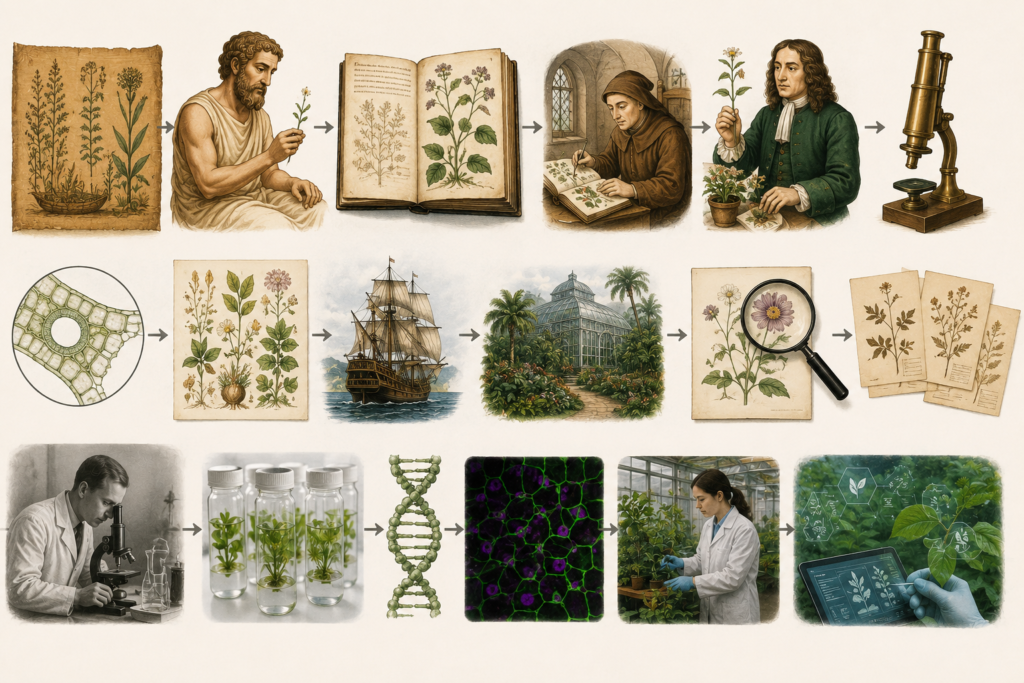
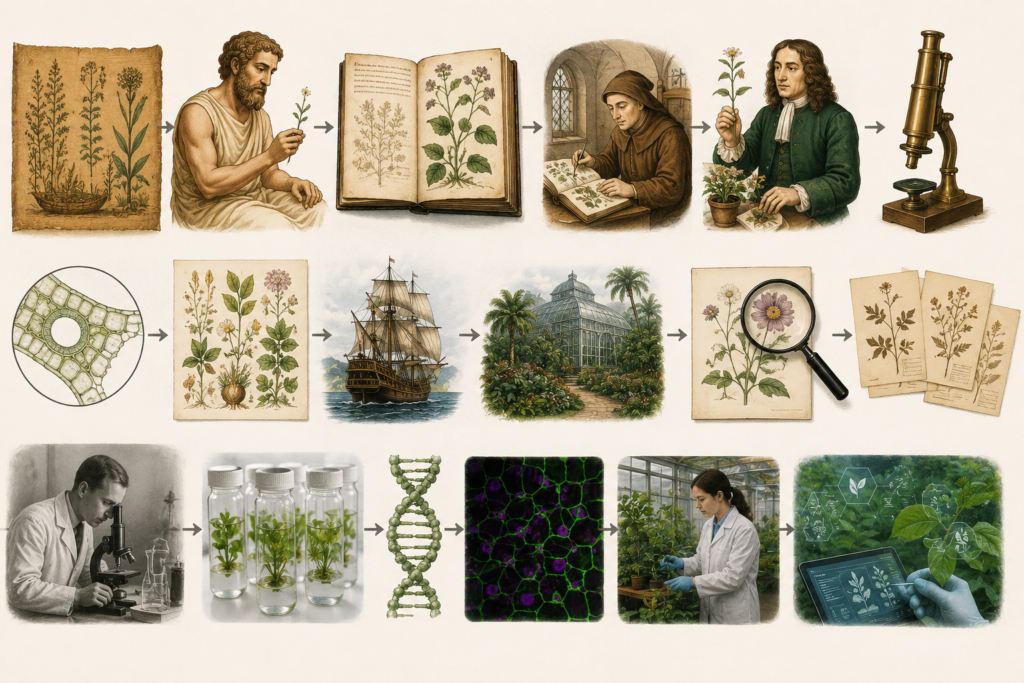
Welcome to a short history of botany. I felt it only fitting to begin with a small and basic history of this fascinating branch (no pun intended) of history and science. As I delve into books, papers and other areas of research I hope to share with you interesting and engaging information to be used to broaden knowledge and provide inspiration.
Botany, the scientific study of plants emerged gradually from ancient practical knowledge systems, medicinal traditions, and philosophical enquiry into nature. This article traces the intellectual and methodical origins of botanical study from early civilisations through classical antiquity and into the early modern period. It will highlight key figures, concept shifts, and institutional developments that transformed plant knowledge into a systematic scientific discipline.
Introduction
Studying plants predates formal science. It is rooted in humanity’s dependence for food, medicine, and shelter. Botany and early botanical thought was not a distinct discipline in its own right. It was part of the larger investigations into natural philosophy and medical practice. When botany emerged as an independent science there had been a long history of observations, classification and gradual separation of empirical inquiry from earlier mythological explanations.
Early Botanical Knowledge in Ancient Civilizations
Early botanical study and understanding was developed across several ancient cultures independently:
- Mesopotamia (c. 3000–500 BCE) :- Ancient writing systems (cuneiform) reveal lists of plants that were used for medicinal and culinary purposes. These ancient texts show us some of the earliest recorded attempts at plant classification.
- Ancient Egypt (c. 1550 BCE) :- An ancient text called the Ebers Papyrus documents hundreds of plant based remedies. Demonstrating a sophisticated knowledge of medicinal flora.
- Ancient China (1st-2nd century CE, Han Dynasty) :- Texts such as the Shennong Bencao Jing (Divine Farmers Material Medica) categorised plants by therapeutic function. It blended empirical observation with cosmological theory.
- Vedic India:- The Atharva Veda and later Ayurvedic texts provided detailed account of medicinal plants. This emphasised the holistic and systemic interpretations of plant properties.
All of these civilisations showed plant study as functional and medical rather than academic.
Classical Antiquity and the Birth of Systematic Botany
It was Ancient Greece where attempts to treat plants as objects of systemic study emerged.
- Theophrastus and Early Botanical Science :- widely regarded as the “father of botany”. His works Enquiry into Plants (Historia Plantarum) and On the causes of Plants represent the earliest known systematic botanical texts. He introduced several foundational concepts:
- Classification based on structural characteristics (trees, shrubs, herbs)
- Observation of plant morphology and reproduction
- Recognition of environmental influence on plant growth
- Attempted casual explanations for plant physiology
Although it lacked modern experimental methods, his work marked a transition from descriptive knowledge to analytical natural history.
- Hellenistic and Roman Contributions:- Later scholars such as Dioscorides expanded botanical knowledge primarily in the context of medicine. His De Materia Medica catalogued hundreds of plants and their pharmaceutical applications, serving as a standard reference for over 1500 years until the 16th century.
Botanical Knowledge in the Medieval Period
Botanical study was preserved and expanded during the medieval period through Islamic, Byzantine, and monastic traditions.
- Islamic Golden Age scholars translated and critiqued Greek botanical texts while adding extensive pharmaceutical observations.
- Herbal compendia in Europe, often produced in monestries, emphasised medicinal plant use but rarely advanced theoretical classification.
- Botanical knowledge remained largely descriptive and utilitarian, with limited emphasis on experimental methodology.
The Renaissance and the Rebirth of Botanical Science
This period in history was marked by a decisive transformation in botanical study.
- The rediscovery of classical texts stimulated renewed interest in plant classification.
- Exploration and global trade introduced European scholars to previously unknown species.
- The invention of the printing press (1436 Johannes Gutenberg) enabled standardised herbals and illustrated plant manuals.
Botanical garden were also established around this time in some cities. Padua in 1545, Pisa in 1544 and Oxford in 1621. These gardens created institutional spaces for systematic observation and cultivation.
Early Modern Systematization
Modern scientific form for the study of botany began to assume in the 16th and 17th centuries. This included some key developments as follows:
- The use of microscopy, enabling detailed study of plant structure.
- Early classification systems based on reproductive organs.
- Increased emphasis on empirical observation and reproducibility.
The advances in this area culminated in the works of taxonomists such as Carl Linnaeus in the 18th century. He formalised binomial nomenclature (naming a species with two terms. 1. Genus 2. Species) and hierarchical classification.
Final Thoughts
The evolution of botany reflects a shift from utilitarian and symbolic plant knowledge towards more systemic scientific enquiry. Early botanical study was inseparable from medicine and agriculture but developed over time into its own methodologies, vocabulary and institutional frameworks.
The key transitions include:-
- Descriptive lists to structures classification systems
- From medical focus to morphological and physiological analysis
- From tradition based knowledge to empirical observation and experimentation.
Conclusion
The origins of botany have no single origin point. They are best understood as a cumulative intellectual tradition. Ancient civilisations provided foundational plant knowledge. But, classical Greece and in particular the word of Theophrastus provided the first systematic discipline. Further developments in the medieval and early modern periods refined and expanded our knowledge. This ultimately established botany as a distinct branch of biological science.
Places of reference
- Theophrastus. Enquiry into Plants.
- Dioscorides. De Materia Medica.
- Aristotle. History of Animals (contextual influence on natural history methods).
- Morton, A. G. (1981). History of Botanical Science.
- Greene, E. L. (1909). Landmarks of Botanical History.
- Jain SK. Ethnobotany. Interdisciplinary Science Reviews. 1986;11(3):285-292. doi:10.1179/isr.1986.11.3.285